
Find an enzyme solution
Compare products and uses in the industry relevant to your work.
Animal feedAlcohol productionDetergent formulation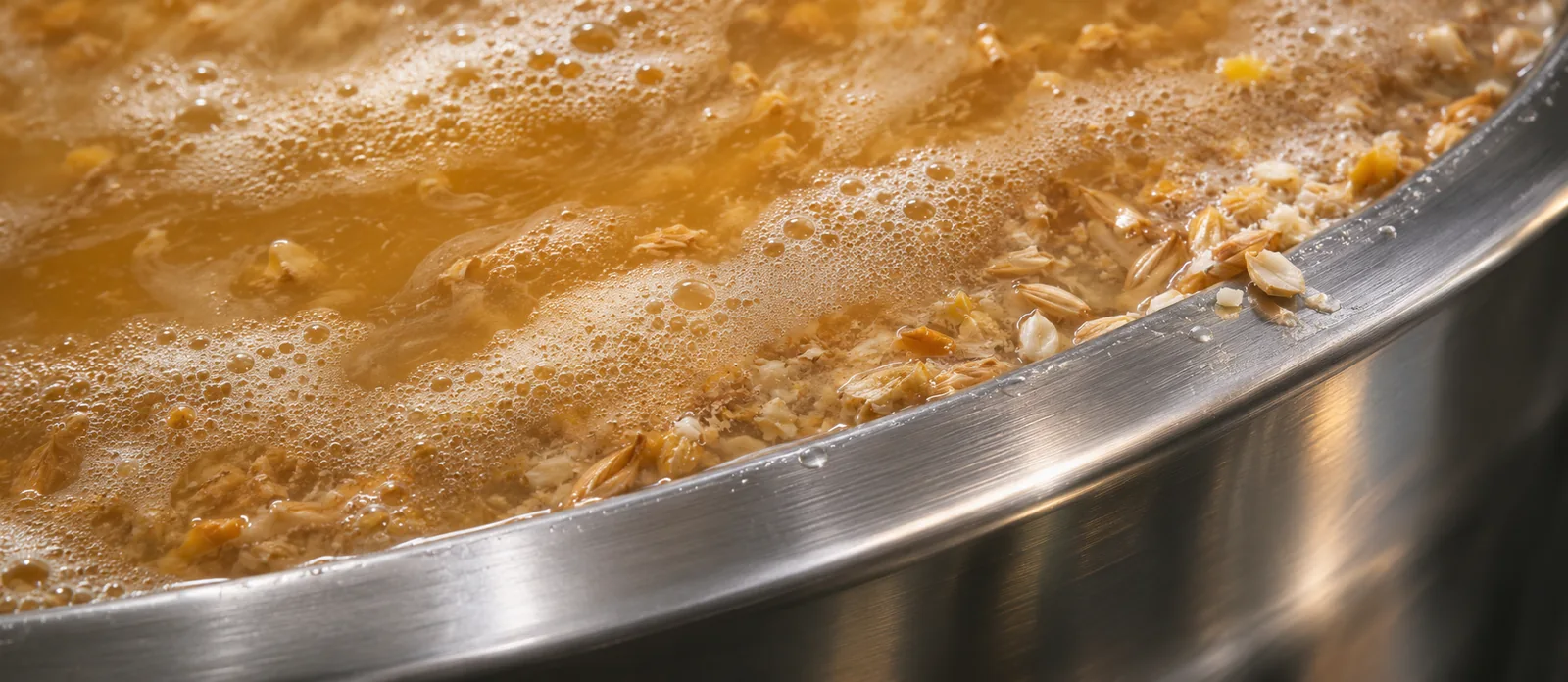
Industrial enzymes are the starting point for SUNSON's biosolutions. Their specific reactions can change how materials behave during processing or how a product performs in use.
Our purpose is healthier lives and a healthier planet. The starch-to-alcohol example shows how enzyme choice depends on the material, process conditions and result you need to measure.
Follow the starch-to-alcohol exampleAI-generated illustration of grain slurry. It is not a SUNSON customer, facility or product-performance record.
The substance involved in an enzyme-catalysed reaction is called its substrate. An enzyme acts on particular bonds or structures within that substrate. The resulting change can alter properties that matter in processing, such as the size of molecules or the way a material separates.
This selectivity explains why enzyme choice starts with the material. A protease cannot replace a starch-hydrolysing activity simply because both are enzymes. The enzyme also has to reach the reaction site; the structure of the material and the way it is mixed can affect that contact.
Starch is the substrate for the liquefaction and saccharification example. Different enzyme activities hydrolyse it in different ways. In other settings, proteases act on proteins in stains, while phytase acts on phytate in plant-based feed ingredients. Each enzyme acts on a different substrate.
An enzyme is the catalyst. An industrial enzyme preparation is the product used in a process and may contain several enzyme activities, carriers or stabilising ingredients. The enzyme name alone does not describe the complete preparation.
Starch must be converted into sugars that yeast can ferment. Alpha-amylase acts during liquefaction, while glucoamylase releases glucose during saccharification. Fermentation then converts sugars to ethanol; distillation is a later recovery step.
Identify the starch-based feedstock.
Alpha-amylase hydrolyses starch chains.
Glucoamylase releases glucose.
Yeast converts sugars to ethanol.
Separate ethanol downstream.
Alpha-amylase breaks starch chains into shorter dextrins. Assess the slurry preparation and heating profile with the enzyme addition point, pH and time. Explore SUNSON HTAA30L for this stage.
Explore HTAA30L alpha-amylaseGlucoamylase releases glucose from starch-derived chains. Explore SUNSON GA130L and match the conditions to the chosen process, including whether saccharification and fermentation are separate or combined.
Explore GA130L glucoamylaseProcess sequence is illustrative. Product instructions and the actual plant conditions determine how each enzyme is evaluated. The diagram is not a trial result.
An illustrative processing sequence. This explanation does not report a SUNSON customer trial or a product-specific operating procedure.
In alcohol production, starch conversion, sugar release and ethanol output require different measurements. Choose the measure that matches your objective.
Use comparable feedstock and process conditions. State the sampling point, assay method and reporting basis. A higher enzyme activity number or a single sugar reading does not by itself establish a greater ethanol output.
| Process question | What to observe | Continue with |
|---|---|---|
| How does starch liquefy? | Record slurry preparation, temperature profile, time and the selected conversion or viscosity measurement. | Alpha-amylase for liquefaction |
| How are fermentable sugars released? | Use a stated assay and sampling point for sugar release or residual starch. | Glucoamylase for saccharification |
| What happens during fermentation? | Keep yeast, time and operating conditions with the method and basis used to report ethanol. | Alcohol-process comparison |
These are evaluation questions, not reported improvements or a ready-to-run test protocol.
An enzyme preparation has to work within your process. Temperature, pH, contact time and mixing affect the reaction. Goals such as lower resource use need their own measurements and a suitable comparison.
A stated temperature range does not guarantee that treatment will reach its target in the time available. Check the product's use range, assay conditions and performance in your process separately.
Define the material and reference treatment before comparing results. Record the enzyme preparation, amount, addition point, process conditions and observation time. Keep the original results and note what changes in the next trial.
Plan a useful application comparisonActivity values need context as well. Before comparing two numbers, check the method, substrate, conditions, units and reporting basis. The larger number alone cannot establish the preparation's suitability for your material.
Before comparing enzyme activity valuesSUNSON studies enzyme-producing strains and how their preparations work in applications. Our manufacturing operations in Yinchuan and Cangzhou bring this development into production.
Our detergent range includes liquid and granular preparations and multi-enzyme blends. Choose both the enzyme function and product form to suit your detergent system.

Our microbial research includes strain screening and breeding. The research collection and gene-sequence submissions to GenBank form part of that work.
Explore research collaborationStart with your material, processing step and goal. Explore SUNSON's tailored biosolutions for animal feed, alcohol production and detergents, or discuss a specific enzyme application with our team.
Compare industries and find relevant enzyme products in Industries & applications.
The explanation distinguishes a reaction from its practical application. See IUBMB enzyme nomenclature and enzyme kinetics terminology for scientific background. Product-specific composition, conditions and performance need the relevant technical record.
For general starch-based ethanol production, see the U.S. Department of Energy process overview. This source explains a process; it does not verify SUNSON product specifications or environmental performance.